Last week I spent three days at a Cantera workshop learning about community development and organizing. We reflected on what works and what doesn’t when it comes to community organizing in a Nicaraguan context, and we shared a lot about our personal organizing experiences. Cantera workshops are always excellently facilitated, and I particularly enjoyed this one because it gave me so many good, concrete tools that I can use in my work at the CCBN. One of the greatest strengths of Cantera workshops is the diversity present in the room. People from all over the country, from NGO’s, from political organizations, and both paid workers and volunteers with a variety of educational backgrounds and economic circumstances, come together to share their experiences and learn from one another.
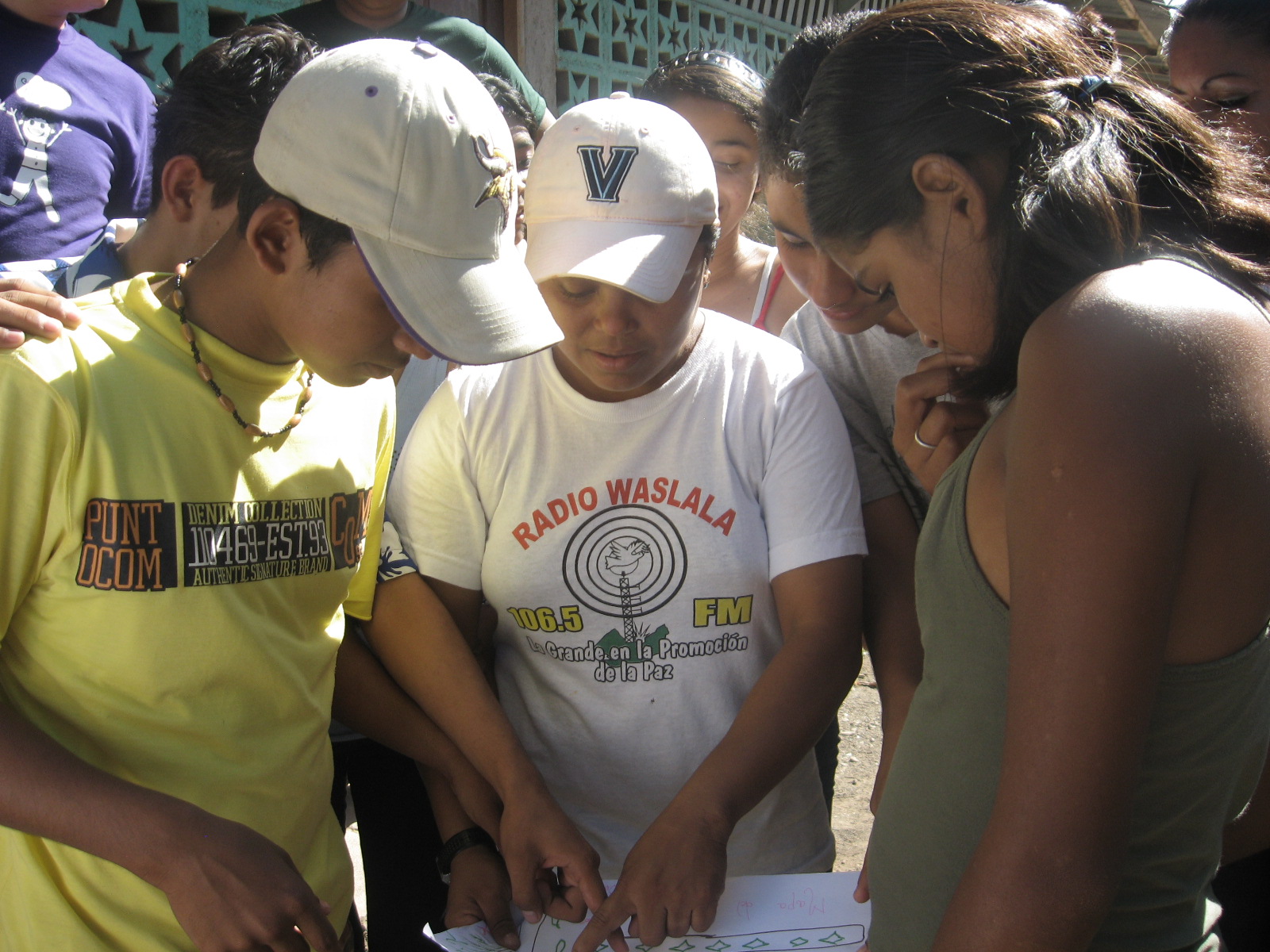
One of the most fascinating aspects of the workshop for me was seeing so many of the same theoretical concepts that I had learned at Industrial Areas Foundation’s national training in 2008, but with different methodological tools. For example, IAF’s basic organizing tool is the relational meeting, sitting down with someone one-on-one and probing them about their hopes, fears, and dreams, in order to identify their self-interest. At Cantera’s workshop, we learned about the importance of self-interest and of tapping into people’s dreams, but instead of starting with a relational meeting, Cantera gave us la muñeca, or the doll, as our initial organizing tool. You being by drawing the figure of a doll on butcher paper. Placing the community’s dream at the head of the doll, the committee writes down their resources and places those at the right arm of the doll. Next they place challenges at the left arm of the doll, and their personal commitments at the heart of the doll. Finally, the group makes a list of the initial steps that need to be taken to make the dream come true and places those at the doll’s feet. This tool is very effective in terms of visually laying out where the community stands in relation to their dream. Seeing these methodological differences caused me to reflect on how context determines effective organizing strategies. In the U.S. organizing context, we are looking for a way to take a much more individualistic culture and make it about community, whereas here, the assumption is that there is already an organized structure in place in the community, and that an outsider (such as an NGO) must learn to work within that structure.
Saturday, May 22, 2010

Tuesday, May 18, 2010
gatito documentary
Good Friday morning. It was hot, and I was still in bed groggily trying to decide if I would be able to sleep a little longer in spite of the heat and take advantage of my vacation while it lasted. The Center was closed during Holy Week except for evening choir rehearsals. As wonderful as it is to listen to all the CCBN’s activities, it sure was nice to sleep in past 8am without being woken up by trombone lessons or recorder class. However, instead of the normal musical din I soon began to hear different kinds of sounds coming from outside, just below my window. It sounded like a kitten. I remembered that the volunteers who lived in the house before us had gained a reputation for taking care of unwanted strays. Groaning inwardly, I rolled over and decided that if it was still there when I woke up again I would figure out what to do with it.
Sure enough, when I opened the front door mid-morning, I found a wee bit of a kitten crying miserably in the corner of the porch. It was still wobbly on its little legs and obviously couldn’t have climbed up the steps by itself, so someone must have left it. Funny, people usually take things from our porch, not leave them (e.g., laundry drying on the line).
I had never taken care of a kitten this tiny, and Amanda hadn’t had any pets at all growing up. Luckily, Laura, one of the previous FOB volunteers and daughter of a veterinarian, had left us a small baby bottle and powdered infant formula for just such occasions. At his arrival, the kitten was so tiny that he even had trouble taking milk from a bottle, and one eye was swollen shut. Now, his eye has healed thanks to some drops, his fleas are gone thanks to a bath, and his little tummy is getting quite plump. He’s even starting to scamper and loves nothing more than to sit between our feet while we are cooking or washing dishes, making it a bit awkward for us to move around the kitchen without stepping on him.
Few of our Nicaraguan friends are as taken with the little guy as we are, but our friend, co-volunteer and freelance filmmaker Melissa Engle has put together a little documentary based on her observations, featured above. At first we were looking to give him away, but no one really seemed interested. Now we’re rather fond of the little guy (okay, okay, I admit I was ready to keep him from the start, but it seemed like Amanda needed a little more time to get used to the idea).
So far we’ve just been calling him “gatito” or “kitty” (not very creative, but easier than felis catus). Other suggestions have been Garfield, Fuzz, and Samson, but we may just end up calling him Tiger. If nothing else, it’ll give him something to aspire to.
Wednesday, May 5, 2010
Center Profiles: Ansony Gutierrez Jimenez

How old are you?
24
What was your first experience at the Center?
My first experience was studying the first level of Adult Basic Education. I got to know a lot of friends through this experience. It was both a fun and sad experience because I was scared to go to the Center sometimes, I was nervous about participating.
What do you currently do at the Center?
I help the guys. I help with security and maintenance, and I’m also in the painting class. The painting class is not easy, when I started, I couldn’t imagine getting involved, it’s a scary thing to put yourself out there, but if you say you can’t, you won’t be able to, and if you say you can, you can. The hardest thing about painting is painting faces. I’ve been painting for almost four years. I still remember my first painting, which I gave to my Adult Basic Education teacher, it was of a boy with a beautiful background of a tree with leaves in the fall, and around the tree were a bunch of kids. Painting has helped me economically because I sell my paintings and that’s helped me meet a lot of people.
Where do you live, and who lives at your house?
I live in Batahola Sur, and I live with my grandmother, two uncles, one aunt, and two cousins.
Who, of those that live at your house, work, and what do they do?
Only one of my uncles works. He works in a cosmetics store.
What do you like to do in your free time?
I like to go out, hang out with my friends, wash my clothes, iron, and go to the gym.
What is your biggest dream?
My biggest dream is to be with my mom in the United States. She has lived in Miami for 14 years and I haven’t seen her since she left.
What is your biggest fear?
My biggest fear is walking into a haunted house!
Why is the Center important to you?
The Center is important to me because I like helping the guys, they help me too, and I’ve learned I don’t need to be too proud. I go to the Center to leave behind my sadness. Once you enter here, you lose your sadness. My sadness is that my house doesn’t have food, that I’ll have to go to bed without eating.

Monday, April 26, 2010
Gender Equality


Last week I attended a 4-day Gender Equality workshop run by Cantera, a local Center for Communication and Popular Education. Cantera tries to address gender inequality as an issue for everyone-not just female feminists. After the initial session, men and women broke off into separate groups.
The women’s workshop focused on themes of identity and social conditions. Most of the activities revolved around sharing personal experiences and working in groups. We filled several sheets of flipchart paper with ideas of who we want to be as women. We sat in small groups on the floor and shared our life stories, then used elements of our own stories to make a composite biography of an imaginary woman for each group. As each group read their story in plenary, the same themes kept emerging-abuse, abandonment, limited access to education, single motherhood, poverty.
Workshop participants came from all over the country and ranged in ages from teenagers to late 50’s. It seems that most of us work for various NGO’s or community organizations that sponsored them to come so that they could pass on what they learn.
Wednesday, April 21, 2010
VMM Video
Check out this video about the work VMM is doing around the world, including interviews with several missioners.
Thursday, April 15, 2010
Waslala

Jose Angel and Erick leading the workshop

Sorting clothes

Me playing Twister
Youth working together

Melissa and Grismaylin carrying supplies

Waslala's natural beauty
Semana Santa, or Holy Week, is a glamorous affair for many in Nicaragua. Attending religious services seemingly takes a backseat to trips to the beach, time with friends, and lots of partying. While many of us in the U.S. (me included) may consider this a week of religious reflection, for many Nicaraguans the hottest time of the year plus universal vacation time equals heading out of the city for some rest and relaxation.
The Youth Group I work with headed out of Managua along with everyone else, but for a slightly different reason. We spent four days in Waslala, a rural area northeast of Managua devastatingly affected by the Contra War in the 1980’s. Because of its distance from Managua, the region is neglected by the government and has limited access to resources. However, it is also an absolutely beautiful part of the country and is actually a protected nature reserve. Within this brief sketch of Waslala you can see the many contradictions and the ways in which life in this region is difficult for its inhabitants.
This was the Youth Group’s second annual visit, and our objectives were to share with the community of Waslala by delivering clothing and school supply donations, leading a self-esteem workshop with children, and learning from the youth and communities about their organizations.
Our time in Waslala was filled with experiential learning:
•What do you do when you’ve run out of food to feed over 100 people who have come to share with you?
•How do you make sure one activity runs smoothly while the next activity is being prepared?
•How do you divide up tasks as a team, making sure everyone feels included AND is doing their share?
•How do you keep a group of 50 children entertained and learning about self-esteem when they range in age from 2 to 12?
•How do you balance learning from the community you’re visiting and sharing your own passions and skills with them?
These are just a few of the tough issues we confronted and learned from as a group. Obviously, there is endless potential for leadership development and teamwork in this experience. The Youth Group did an excellent job responding to these issues, organizing themselves, and learning from one day to the next how to make their events run more smoothly. We also experienced profound sharing with the youth in Waslala who accompanied us every step of the way.
One insight from a group member that particularly struck me was: “These communities don’t need our help. We need to come here and learn from them how to better-organize ourselves.” Exactly.
Monday, March 15, 2010
Going to the Venta

It’s 6:30pm, and Amanda and I are just getting home. Hmmmm, not much in the kitchen to cook for dinner...luckily, there are several ventas all within two blocks of our house in Batahola. Ventas are like small convenience stores, usually on the porch or front room of someone’s home. While you can usually find all the staples such as rice, beans, oil and sugar, there isn’t much to choose from as far as produce is concerned, beyond the crucial onions, tomatoes and plantains. The venta is also a convenient place to buy prepaid minutes for our cell phones
Most of the items sold at the venta can be bought per unit rather than per package. You can get one egg for 15 cents, a stick of butter for about a dollar. Rice, beans, and sugar are sold per pound. You can buy a single roll of toilet paper, and even bring in an empty plastic soda pop bottle to refill with vegetable oil. This makes it easier for households that rely on a small daily cash income to buy only what they need for the next meal. Also, it’s not really common to stock up on cooking ingredients here, since not every home has a refrigerator.
The abundance of ventas makes me think that they’re a popular small business venture. Venta owners can start out small by buying a few products and gradually expand their inventory. And there is the convenience of working at home, where you can take care of your kids, clean or cook meals whenever there are no customers. According to statistics, most venta owners are women. However, it seems that I have seen multiple family members sharing the tasks in every venta I’ve been to.
For us, the best part thing about the ventas is that they are close enough that it only takes a few minutes to get last minute dinner or breakfast supplies. The problem is remembering to get everything we need in one trip!
Thursday, March 11, 2010
Solidarity, Art, and Change
.jpg)

Recognizing and taking advantage of the potential for human development and not just artistic development in arts formation is an integral part of the mission of the CCBN, a goal that is being realized through retreats, recreational activities, and gender discussions with the arts groups. I have spent several evenings and Saturdays in retreats and discussions with youth from all the arts groups at the CCBN: choir, orchestra, theater, painting, and dance. We’ve played, we’ve sung, we’ve danced, and we’ve shared about our experiences as artists and as young people.
Before the closing retreat, several of the youth expressed concern to me that they wouldn’t get along well with the youth from the other groups. Seats on the bus were clearly divided by arts group, and our initial circle of chairs was also pretty segregated. By the end of the day, though, everyone was mixed up, laughing and sharing their art with each other.
I’ve been interviewing some of the youth to document their reactions to the events and get their ideas for the future. Many have shared that they learned much about the values of solidarity, respect, and camaraderie. But what most struck them is the way in which they were able to share with members of the other arts groups, despite the fact that they had never really gotten to know each other before. The youth are energized, and they are taking that energy back to their rehearsals and performances, strengthening both their artistry and their sense of identity.
Wednesday, February 24, 2010
Recognizing God in the Tiniest Flicker
Last weekend Greta and I attended Volunteer Missionary Movement’s annual retreat in El Salvador. We gathered with our fellow Central American VM’s and shared stories about our work and the current political situation in our countries, reflected on how we’ve changed since beginning our time with VMM, and recalled what it means to be a missioner for life. Edwina Gateley, founder of VMM, joined us for the retreat, sharing her wisdom on being part of the movement.
Edwina reminded us that our “mission” with VMM is not simply a two-year stint, but a lifetime commitment to bringing about the reign of God by working for peace and justice. I feel pretty uncomfortable calling myself a “missionary,” and it was good to be reminded that the kind of mission VMM is talking about is not an evangelical one. Instead of bringing God to the people, Edwina talked about learning to recognize God, both in ourselves and in those around us. For us as volunteers this was a an affirmation that no matter what challenging circumstances we find ourselves in (and they are numerous), we should know God is with us, and remember to recognize the ways in which God is moving in our lives. Edwina explained that all we have to do is find the tiniest flicker of hope and know that God is present. For the communities with whom we are serving, we affirm their recognition of God’s presence. It is not about bringing God, or even finding God, but creating opportunities and spaces for community members to recognize God in their own lives. In this way, mission becomes a mutual exchange of support and affirmation.
We also spent time discussing the political and social realities of each of the countries we are serving in and in Central America as a region. Currently, VMM has missioners in Guatemala, El Salvador, and Nicaragua. Tim Muth, a VMM board member who joined us on the retreat, has a great blog on all things El Salvador. He and the other volunteers in El Salvador talked about the gang violence gripping El Salvador and the politics behind the campaign against it. Those of us from Nicaragua struggled to explain the tension between social programs and corruption under Daniel Ortega. For more information on this ongoing Nicaraguan debate, read NACLA articles that offer both a more positive view of Ortega and a more critical perspective.
Edwina reminded us that our “mission” with VMM is not simply a two-year stint, but a lifetime commitment to bringing about the reign of God by working for peace and justice. I feel pretty uncomfortable calling myself a “missionary,” and it was good to be reminded that the kind of mission VMM is talking about is not an evangelical one. Instead of bringing God to the people, Edwina talked about learning to recognize God, both in ourselves and in those around us. For us as volunteers this was a an affirmation that no matter what challenging circumstances we find ourselves in (and they are numerous), we should know God is with us, and remember to recognize the ways in which God is moving in our lives. Edwina explained that all we have to do is find the tiniest flicker of hope and know that God is present. For the communities with whom we are serving, we affirm their recognition of God’s presence. It is not about bringing God, or even finding God, but creating opportunities and spaces for community members to recognize God in their own lives. In this way, mission becomes a mutual exchange of support and affirmation.
We also spent time discussing the political and social realities of each of the countries we are serving in and in Central America as a region. Currently, VMM has missioners in Guatemala, El Salvador, and Nicaragua. Tim Muth, a VMM board member who joined us on the retreat, has a great blog on all things El Salvador. He and the other volunteers in El Salvador talked about the gang violence gripping El Salvador and the politics behind the campaign against it. Those of us from Nicaragua struggled to explain the tension between social programs and corruption under Daniel Ortega. For more information on this ongoing Nicaraguan debate, read NACLA articles that offer both a more positive view of Ortega and a more critical perspective.
Monday, February 8, 2010
Obama and Latin America
Here's an excellent article by the Council on Hemispheric Affairs that reviews Obama's first year in office in terms of his Latin American policy.
Friday, February 5, 2010
Facing Poverty and Privilege

I have no idea what the word “poverty” really means. In the United States, “poverty” is the government designation for the income level at which a family of a certain size cannot meet their “basic needs.” In Nicaragua, poverty means living on less than a few dollars a day. So is poverty relative? I don’t really know. But whatever you call it when someone can’t make ends meet or they skip a meal so their kids don’t have to or they work five jobs and barely scrape by or their children are exceptionally small because they were malnourished at some point, how do those of us with more than enough money and security in our state of excess respond to it? Do we throw money at the situation, give away all we have, lend money, refuse to give money because we believe in justice, or do we simply make sure never to be in a situation where we’re faced with that choice?
I certainly don’t actively seek out people who society labels “poor” just to force myself to face my privilege. But here in Nicaragua, I can’t choose to avoid it as easily as I can in the U.S. Whether it’s my friend asking me for a loan for her son’s school registration fee, a neighbor coming by my house asking for food, a blind man begging on the bus, or an English student who can’t afford their textbook, I frequently feel a familiar pang of guilt mixed with I’m-a-graduate-of-a-liberal-arts-college-and-we-have unpacked-our-privilege mixed with helplessness mixed with relief: “I’m glad I have the money not to be in that situation.”
Did I really just say that? Yup. Truth be told, it’s uncomfortable to ask for a loan or a handout, and I thank God (not every day, just when I’m faced with the issue) that I don’t struggle to pay my bills and can by a ticket home whenever I want. And that’s when I’m living on a volunteer’s stipend.
So aside from mixed feelings and the urge to run away, what do I do when I face a blind man on the bus asking me for money? I passively stare straight ahead (or out the window), don’t give him anything, and then I reflect on the pop culture question ‘What would Jesus do?’ Certainly not what I just did. I conclude that not only am I not Jesus, but our world is so broken I firmly believe that the “right” thing to do is the opposite of what Jesus would do.
I’ve been taught from a young age that handouts are not great – not justice, not the way to bring someone out of poverty, better to give your money to an organization who can distribute it properly. Whatever that means. Being a Christian, especially a Catholic, means justice, not charity. Which means God wants systemic change, genuine equality, not $.25 handouts. So I don’t give money. Because of that lesson, and because I selfishly don’t want to play the game where every time someone approaches me for money I debate their sincerity and make a judgment, more likely to be based in racism, classism, ageism, sexism, and outfit-ism, than anything else. I’d rather not dirty myself with those kinds of judgments. So I avoid eye contact and reflect on the fact that I think I’m actually pretty sure Jesus would give money to every person that asked for it. Never mind that that might be a lot of people, and never mind that they might spend it on drugs or alcohol or other sinful substances. Jesus would not judge, he would simply show love in the moment and share of himself, perhaps offering a word of encouragement or kindness. (Of course, he would do all this without being the least bit patronizing and while continuing to work for systemic change in other ways. But that’s a whole other issue). And so I hold tightly to my money, feeling disgusted with myself that on one of the rare occasions I actually feel pretty certain about what Jesus would do, I can’t even bring myself to follow in his footsteps because it’s just not “right” in today’s world.
Tuesday, January 19, 2010
Luchando for Christmas All Year ‘Round

For me, what most significantly marks Christmas here is the choir music. Instead of singing about angels, Santa, and even the traditional Nativity scene, most of our Christmas carols talk about Christmas as a state of being, one marked by conscience, solidarity, and action. During the Christmas season I sang over and over again about how Christmas should be present the whole year around in the struggle for social justice and the way we relate to one another.
For example, in “Navidad sin estruendo” or “Christmas without Thunder,” the chorus says:
“To Bethlehem we come and go by pathways of joy, and God is born in each one who devotes themselves to others. To Bethlehem we come and go by pathways of justice, and in Bethlehem people are born when they learn to struggle.”
The word luchar, which I’ve translated here as “struggle,” is the principle word used in Spanish to describe that state of working towards and hungering for social justice. To understand the miracle of Christmas as the birthing of luchadores/as, or “strugglers for social justice,” is striking because we usually associate images of gentleness and passivity with the Christmas story. Struggle, however, has little to do with sitting and waiting patiently. How much more meaningful is the Nativity scene when we reflect on the difficult journey that brought Mary and Joseph to the stable, and when we remember the struggle that Jesus chose in his adult ministry? As a poor, unwed-but-pregnant couple, Mary and Joseph were labeled as sinners by their society, but instead of listening to the criticism, they chose to glorify God by following his plan for them. And as a prophet speaking truth-to-power, Jesus faced both political and personal adversity, glorifying God with his peaceful but revolutionary stance.
The second and third verses of this carol talk about the people awaiting a rich, submissive, kingly figure as their Christ, and how instead, they got a poor but powerful-with-words baby who denounces oppression and proclaims liberation in the name of God. Of course, I, too, love the image of Jesus as a babe wrapped in swaddling clothes, lying in a manger. But that image moves me more when I, like Mary, ponder in my heart the future of the baby and how I can radicalize those around me in the name of Love and Justice (aka God).
The song goes on to say in its final verse:
“Christmas is a pathway that doesn’t produce a great thunder, because God resounds within those who walk in brotherhood. Christmas is the miracle of going door-to-door and finding out if our brother needs our bread.”
And so it isn’t about changing the world alone, miraculously birthing a divine but human savior, or gift-giving. It’s about an awareness of and willingness to struggle with those around us for God’s abundant life.
Click here to hear the choir singing another Christmas carol.
Subscribe to:
Posts (Atom)