Monday, February 28, 2011

Friday, February 25, 2011
A Sandinista Perspective

Tuesday morning I attended Envio's monthly lecture on Nicaraguan current events. The speaker was William Grigsby, director of La Primerisima radio station and an outspoken Sandinista. The topic was "How is the Sandinista party entering this election year?" Grigsby gave a well-organized speech about how the party is feeling about their chances this November. Knowing his audience would be highly critical of many of the FSLN moves in recent months, he directly addressed well-known criticisms and did not shy away from brutal honesty.
Grigsby began by explaining that, up to this point, the FSLN has succeeded in re-ordering the country's priorities, putting the economy, energy investment, and infrastructure first. But they are not finished with their work, which is why they need more time in office. Current social programs are the seed for future development, and one more term will see that development through. The FSLN has an "efficient electoral military," which means prospects look good for November. Grigsby stated, though, that it would still be a tough fight with the country's second-in-command political party, the PLC (Constitutionalist Liberal Party). He doesn't see popular radio personality Fabio Gadea, running on the PLI (Independent Liberal Party) ticket, as a threat at all. The fact that Gadea's candidature is splitting the liberal (read: right-wing) vote means that the election atmosphere favors the FSLN.
Then he tackled that-which-must-not-be-named with Sandinistas (or that which is being screamed at the top of the opposition's lungs): institutionality. The accusations are clear: the FSLN is destroying institutionality because they are authoritarian, and they are violating the consitution and electoral law. The response from Grigsby was also clear: the ends justify the means. While he did not use these words (in the discussion period afterwards, the audience agreed upon this as a fitting catchphrase for Grigsby's message), he did remind us that all these issues are the result of politics. Politics wrote the constitution of 1987, amended it in the coming years, and wrote electoral law. Not the FSLN, but the various political forces who have risen and fallen in Nicaragua's recent history. Special interests always win out, and because of this, life and elections are not always fair and clean. According to Grigsby, "With this same institutionality they [the opposition] messed up the Nicaraguan people for 17 years, it's [institutionality] at the service of some particular interest, usually an economic interest." He points out that the FSLN doesn't even have a political majority in Nicaragua, so they can't be dominating the rule making that much. That's just the way the game is, and the FSLN is going to play it (and play it well) this time around.
And as for election observers, they don't always guarantee a fair election, anyway. (Background: International observers are a hot topic right now because Denmark just declared they are pulling their aid out of the country, in part due to Ortega's refusal of international election observers). But, he conceded, observers do help with legitimacy, so the coming election will probably, in some way, shape, or form, have observers or accompaniers. The most important thing is that these elections be Nicaraguan elections. Nicaragua is one of a handful of Latin American governments that has a national agenda and does not simply cater to U.S. interests. One great Nicaraguan accomplishment is that neither the PLC nor the FSLN are U.S.-supported parties. The embassy knows that sometimes they can work better with the PLC, and sometimes they can work better with the FSLN, so no one party solely represents U.S. interests. Nicaragua's political parties are all looking out for national interests, and voters don't feel the pressure to vote for or against foreign money.
Since Grigsby did not leave much time for questions, most of the audience's thoughts came out in the discussion period which followed, led by Envio founder and editor Maria Lopez Vigil. She was quick to point out that many of Grigsby's historical facts were off, particularly those passing judgment on past fraud and changes in the law. Remember, Aleman and Ortega have a pact, so if PLC candidates are voting for law or constitutional changes that favor the FSLN, it's as good as the FSLN voting for it themselves. And it's part of this arrangement that the two parties be seen as important forces in Nicaraguan politics. In other words, the FSLN needs the PLC to be a strong party because they guarantee a split right-wing vote. Vigil described the situation as one of "Who's the livliest rat?" Forget values, what really matters is who's got the stamina and cunning to outsmart his opponent. According to Vigil, "The only flag that an opposition should be waving is that of fiscal reform." The message? If civil society has a problem with transparency or corruption, they should form a political party and join the game. But electoral law makes it nearly impossible to do this. So they're stuck between a rock and a hard place, choosing between ideals and practicality.
Powered by Qumana
Wednesday, February 23, 2011
Co-Worker's Blog
Check out our co-worker Darling's blog. She is the coordinator of the Gender Violence Prevention project at the CCBN, and has done a lot of work with women's organizations in Nicaragua.
Powered by Qumana
Wednesday, February 16, 2011
It's an Election Year
I have been struggling to write this blogpost for weeks. Although this year’s presidential elections aren’t for another eight months, there is plenty happening now that will affect the outcome in November. It seems like such a complicated mess that I haven’t known where to begin. I want to represent the situation fairly, and yet I certainly have my biases. But the Egyptian people’s success at making their voice heard and enacting change in their country has inspired me to finally put pen to paper, or rather, hand to keyboard. The question around here has been “If Egypt can do it, can we?” I have a co-worker who thinks that if Egypt did it in 18 days, Nicaragua can do it in 15. Not everyone wants to get rid of current president Daniel Ortega, but there is a lot of controversy surrounding his bid for re-election.
According to the Nicaraguan constitution, a current president cannot run for re-election during his term. He must wait at least one election cycle before entering the race again. Additionally, the constitution states that no person can be president more than twice, and Daniel Ortega has reached his limit, having served one term in the 1980’s and another one now (if you speak Spanish, Google “constitución de Nicaragua” and scroll down to Artículo 147). After failing to get the votes he needed in Congress to change the constitution, Ortega still managed to “allow” his own re-election thanks to his friends on the Supreme Court, a completely unconstitutional procedure. Many may ask, how is this even possible? Simple. Remember Arnoldo Aleman, president of Nicaragua prior to Ortega? The one who stole a ton of money from the country? He’s not in jail, or even under house arrest anymore. Why, you ask? Because he formed an alliance (“El Pacto”) with Ortega years ago, which has turned into a series of traded favors and divvying up of political posts and institutions. The latest in the chain of corruption is Ortega’s reprinting of the constitution and Aleman’s running for the presidency yet again, because his bid guarantees a split opposition vote which in turn guarantees Ortega’s win. Though not by a majority vote, which, again, is technically unconstitutional. So, in conclusion, Ortega and Aleman continue to be the big political players, the general public is well versed in their chronicle of corruption, and any other candidates have little chance at upsetting the system.
This is a basic outline of the election set-up, although it says nothing about the candidates themselves and their political platforms. By March 18, 2011, parties must declare their candidates, and this process has also engendered all kinds of corruption (i.e. abrupt and illegitimate changes to electoral law and cancellation of some political parties’ legal status). But, the campaigning goes on, and while Nicaraguans are divided on whether Daniel Ortega’s re-election would be a good move for the country, most Nicaraguans agree that Ortega will be the winner of the next election, whether legitimately or not. At the same time, a lot can happen between now and November. How will the Nicaraguan people make their voice heard during the campaign? Will the international community recognize the outcome? If Nicaraguans protest the process, what can the goal be? How likely is an unexpected outcome? As U.S. citizens with a government claiming to promote democracy around the world, it is our responsibility to use our power and privilege to promote real democracy, not simply a cover. One way we can do this is to stay informed about Nicaragua’s elections and lobby our government to not look the other way when political injustices are committed. The U.S. has already unofficially cast their vote for Ortega, quietly applauding his ability to keep within their neoliberal economic system. Over the next several months I hope to continue writing about the elections, both from my own perspective, and from the perspective of a diverse group of every-day Nicaraguans. I will post a series of interviews so you can hear, in their own words, local perspectives on these issues.
For a more detailed account of the election process in the last few months, including a more substantial description of candidates and information on the U.S. stance, read this article from November’s issue of Envio.
For more history on The Pact, read this article from January 2000’s issue of Envio.
And, for continuous coverage of the election, check out Tortilla con Sal for a more Danielista perspective and Confidencial for less of one.
Thursday, February 10, 2011
English Class Profile
Our new English group has just finished their second week of class. Their energy and attention has been incredible, as well as their punctuality and willingness to work together. So far so good! Here are some numbers based on interviews we did with each of them:
27 students, ranging in age from 14-53
18 women
9 men
12 parents
1 married couple
2 single mothers
2 high school students
8 university students (studying law, languages, journalism, electric engineering, graphic design, applied economics, and special education)
1 technical education students (studying to be a bilingual secretary)
1 architect
1 actress
1 karate student
1 bartender
4 volunteering or working for an NGO or community-based organization
1 dance teacher
5 looking for work
4 women who work in the home
6 working for themselves in a small business
7 with jobs in the formal labor sector
22 who want to learn English to get a better job


Thursday, January 27, 2011
Nicaragua: Surviving the Legacy of U.S. Policy
Check out this amazing book of photography depicting the legacy of U.S. foreign policy in Nicaragua. The book will be available in April and can be pre-ordered on the website.

Thursday, January 20, 2011
Arts for Hope Camp


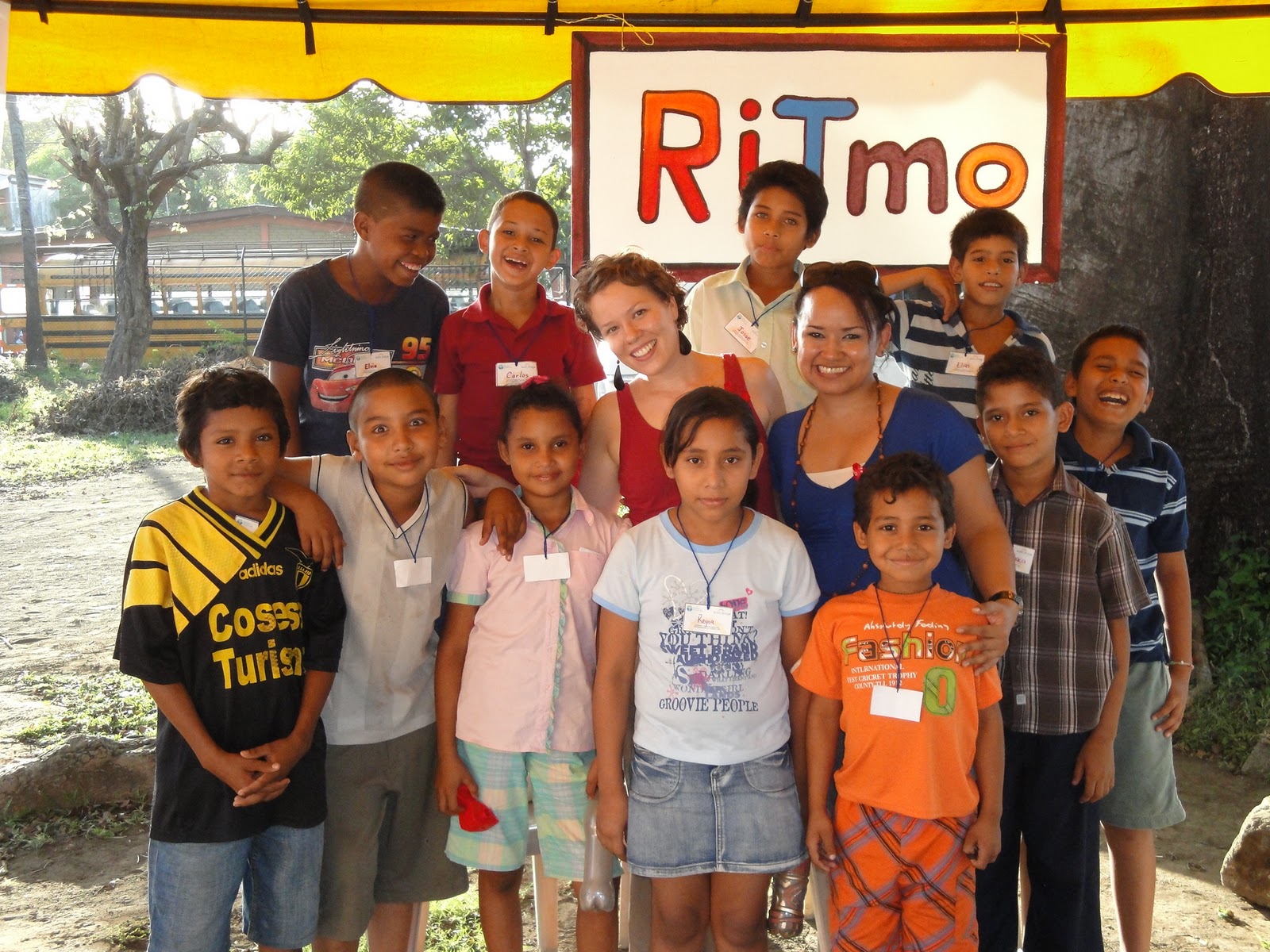
In the beginning of December I had the opportunity to participate in an Arts for Hope camp for children living in extreme poverty in Chinandega, Nicaragua. The camp used the methodology of Build a Bridge, a faith-based organization that seeks to use the arts in processes of healing and building emotional skills. A fellow volunteer who had participated last year told me about it, so I jumped at the chance to learn more when I realized Build a Bridge would be in Nicaragua again. Because they were short of hands, I was able to assist a teacher named Iskra with Rhythm class.
Preparation for the camp classes began in November with a workshop about planning art, choir, rhythm, crafts and dance lessons that reach the four main objectives of Build A Bridge: academic learning, community building, spiritual values and artistic expression. For example, using what we learned in the workshop, Iskra and I brainstormed to choose songs and games that would help the kids learn about musical notation and note values, learn to work together, be inspired with hope, and perform in the presentation at the end of the week.
Each afternoon, 60 kids from three marginalized communities arrived at the church in a battered old school bus. Our rhythm class was held under a tent set up in the dirt parking lot. The instruments we used were our clapping hands and shakers made from plastic bottles and gravel. Our dozen students ranged in age from 6 to 12 years old. It was a delight to get to know the kids just a bit during the three days I was with them. I saw the most timid ones overcome some of their shyness, and the most boisterous ones calm down slightly as we formed relationships of mutual respect and got better at planning the pace of the lessons.
It was an enriching experience for kids and teachers alike, and I hope to apply some aspects of the methodology in English class this year.
For more information about the Nehemiah Center, through which the camp was organized, go to http://www.nehemiahcenter.net/English/index.asp
Wednesday, January 19, 2011
The Story of Stuff
Check out this informative and engaging video on where all our stuff comes from and what happens to it when we throw it out.
Monday, December 6, 2010
Photos from the Cierre Cultural
On Saturday the CCBN celebrated its students and their accomplishments of the past year with the closing cultural show. Dance, music, painting, and theater made up the program. Here are some pictures:


Thursday, December 2, 2010
30th Anniversary of the Four Churchwomen Martyrs in El Salvador
Today we remember Ita Ford, Dorothy Kazel, Maura Clarke, and Jean Donovan, four U.S. churchwomen who were brutally killed for accompanying the poor on December 2, 1980, in El Salvador. Maura Clarke had worked in Nicaragua and was a friend to Sister Margarita of the CCBN.
Speaking about her accompaniment, Ita Ford said, "Am I willing to suffer with the people here, the suffering of the powerless, the feeling impotent? Can I say to my neighbors I have no solutions to this situation; I don't know the answers, but I will walk with you, search with you, be with you. Can I let myself be evangelized by this opportunity? Can I look at and accept my own poorness as I learn it from the poor ones?"
Check out this article from National Catholic Reporter for more about their lives and deaths.
VMM Newsletter
Check out Volunteer Missionary Movement's latest newsletter. Be sure to look on page 3 for past volunteer Christine Ruppert's perspective on transitioning back to life in the U.S.
Friday, November 26, 2010
Jesuit Martyrs
Here's a great article by Dean Brackley giving a more detailed account of the death of the Jesuit martyrs in El Salvador in 1989.
Subscribe to:
Posts (Atom)